


Language
ENG
Enter Keywords...

NEW

Why Banjo Fittings Are Used for Multi-Angle Hydraulic Connections
 2026.08.24
 industy news
The Direct Answer: Why Banjo Fittings Solve the Multi-Angle Problem
Banjo fittings are used for multi-angle hydraulic connections because the hollow bolt at their center allows the flat, ring-shaped banjo body to rotate freely around it before final tightening, letting the hose or line exit at virtually any angle without needing a pre-bent or angle-specific fitting. This is fundamentally different from a standard threaded fitting, which locks into a fixed orientation the moment it's torqued down — if the hose needs to exit at an odd angle to clear an obstruction, a threaded fitting often can't accommodate it without adding an elbow adapter, while a banjo fitting simply rotates into position before the bolt is tightened.
How a Banjo Fitting Is Built
A banjo fitting consists of three core parts working together to create both the rotational freedom and the seal:
- Banjo Body: A flat, ring-shaped fitting (resembling the body of a banjo instrument, which gives the fitting its name) with a hose or tube connection on one side and a through-hole in the center.
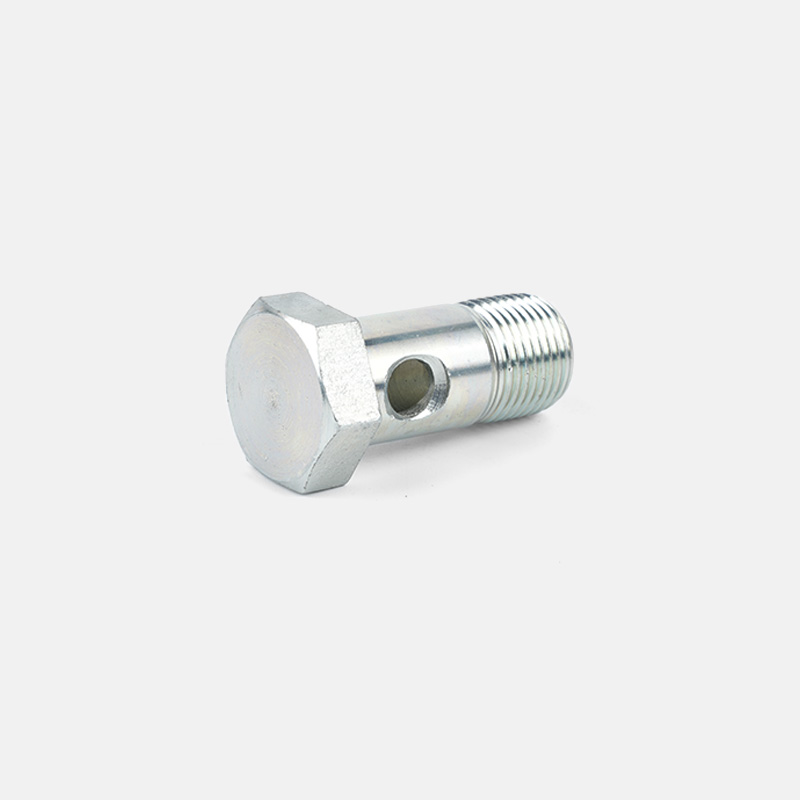
- Banjo Bolt: A hollow bolt with a drilled cross-hole near the head, which passes through the center of the banjo body and threads into the mating port, allowing fluid to flow through the bolt itself into or out of the banjo body.
- Sealing Washers: A pair of soft metal or composite washers placed on either side of the banjo body, compressed between the body and both the bolt head and the mating surface to create a leak-tight seal.
Because the banjo body isn't threaded onto the bolt itself — it simply sits over the bolt shaft and pivots freely — the installer can rotate the entire fitting to any angle around the bolt's axis before final tightening, which is the mechanical basis for the fitting's multi-angle flexibility.
Key Scenarios Where Multi-Angle Flexibility Matters
Tight Clearance Installations
In compact assemblies such as motorcycle front brake calipers, engine bays, or hydraulic cylinders in confined machine housings, there's often very little room to route a hose or line. A banjo fitting lets the installer swing the hose connection point to whatever angle clears surrounding components, rather than redesigning the routing path around a fixed-angle fitting.
Multiple Lines Converging at One Port
Some applications, particularly automotive and motorcycle brake systems, use double or triple banjo fittings that stack multiple banjo bodies on a single extended bolt, allowing two or three separate lines to connect at one port. This is only practical because each banjo body can independently rotate to its own optimal angle, letting multiple hoses route in different directions from a single shared connection point.
Components That Rotate or Articulate
On steering systems, articulating cylinders, or any component that changes orientation during operation, a banjo fitting's ability to be set at a specific final angle — chosen to accommodate the component's full range of motion — reduces stress on the hose compared to a fixed fitting that might force the hose into an awkward bend at certain points in the component's travel.
Banjo Fittings vs. Standard Threaded Fittings
| Feature | Banjo Fitting | Standard Threaded Fitting |
|---|---|---|
| Angle Flexibility | Full 360° rotation before tightening | Fixed by thread orientation |
| Space Requirement | Compact, low-profile connection | May require added elbow adapters for angle |
| Sealing Method | Crush washers on both faces | Thread sealant, flare, or O-ring |
| Multi-Line Capability | Stackable on one bolt (double/triple banjo) | Requires manifold block or separate ports |
Why the Washer Seal Design Supports This Flexibility
A key reason banjo fittings can rotate freely without compromising the seal is that the sealing surfaces are flat, crushed washer faces rather than threads or a machined flare. Because the seal comes from compressing soft copper, aluminum, or composite washers between flat surfaces, the final rotational position of the banjo body has no effect on seal integrity — unlike a threaded connection, where the final tightened position is dictated entirely by where the threads happen to stop.
This is why installers should always use new washers with each installation rather than reusing old ones — a used, already-crushed washer may not compress evenly against the new mating surfaces, undermining the seal regardless of how well the fitting is torqued.
Common Industries and Applications
The multi-angle advantage of banjo fittings has made them the standard choice across several industries where space and routing flexibility are constant challenges:
- Automotive and Motorcycle Brake Systems: Connecting brake lines to calipers and master cylinders in tight wheel-well and handlebar spaces.
- Fuel Injection Systems: Routing fuel lines to injectors in engine bays where clearance around the cylinder head is limited.
- Mobile and Off-Road Equipment: Hydraulic cylinder and valve connections in compact equipment housings with limited routing space.
- Turbocharger Oil Lines: Connecting oil feed and return lines in the confined space around a turbocharger housing.
Installation Considerations for Getting the Angle Right
Because the whole point of a banjo fitting is angle flexibility, it's worth taking a moment before final torque to confirm the hose or line will clear all surrounding components through its full range of motion, not just in the static position it happens to sit in during installation. Once the banjo bolt is torqued to spec, the fitting's angle is locked, so double-checking clearance at this stage avoids having to loosen, re-position, and re-torque with a fresh set of washers — since reusing washers after breaking the seal is not recommended.
Final Takeaway
Banjo fittings are used for multi-angle hydraulic connections because their hollow-bolt design lets the banjo body rotate freely to any angle before tightening, while flat crush washers maintain a reliable seal regardless of the final rotational position. This combination makes them the practical choice wherever space constraints, multiple converging lines, or component movement rule out a fixed-angle threaded fitting — provided installers use new washers with every installation and confirm hose clearance through the full range of motion before final torque.

Custom hydraulic accessories
From concept to production, we can create the products you want
Products
Contact Information
-

Tel: +86-159-6851-8588
-

E-mail: [email protected]
-

Add:Zhu Jia Station Village, Diankou Town, Zhuji City , Zhejiang Province, China
