


Language
ENG
Enter Keywords...

NEW

How to Correctly Identify Hydraulic Adapter Thread Types and Sizes?
 2026.03.09
 industy news
In the maintenance and design of hydraulic systems, accurately identifying Hydraulic Adapters is the cornerstone of ensuring safe, leak-free operations. Faced with a global array of thread standards—from American JIC and NPT to British BSPP and German DIN—even experienced technicians can find themselves confused. Incorrect identification not only extends downtime but can also lead to high-pressure injection accidents due to mismatched fittings.
1. Essential Tools and the Initial Visual Inspection
The first step in identifying a hydraulic fitting is not measurement, but a systematic visual observation to narrow down the possibilities. Before starting, you need to prepare three core tools: Digital Calipers, a Pitch Gauge (Thread Comb), and a Hydraulic Thread Identification Manual.
Identifying the Sealing Method
The sealing method of a hydraulic adapter determines the physical function of its threads. In the field of fluid power, threads are generally divided into two categories: “sealing threads” and “fastening threads.”
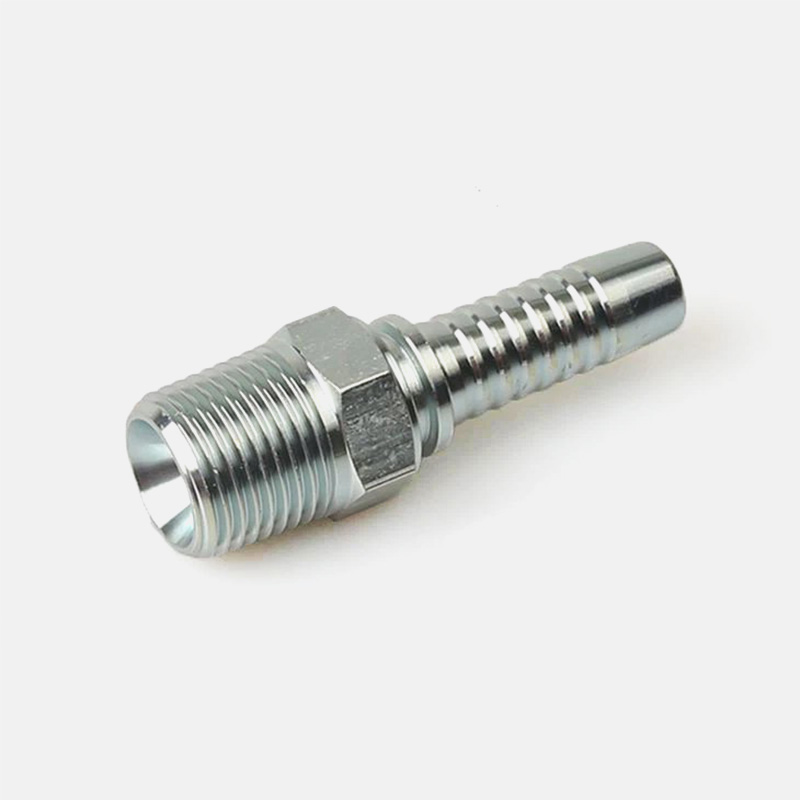
- Tapered Threads: These threads get tighter as they are screwed in, creating a seal through thread interference. Typical examples include NPT (National Pipe Tapered) and BSPT (British Standard Pipe Tapered). Visually, you will notice the diameter of the threads increases gradually from the front to the back.
- Parallel Threads: The threads themselves do not seal; they serve a fastening function. The seal is achieved by an O-ring or a metal washer. Examples include ORFS (O-Ring Face Seal) or BSPP (British Standard Pipe Parallel).
- Mechanical Seats: Check the end of the fitting for a chamfer. A 37° chamfer is typically the JIC standard, while a 45° chamfer is common in SAE standards. Identifying the chamfer angle is critical, as 37° and 45° fittings look extremely similar but are never compatible.
Observing Physical Characteristics
Look for specific markings on the fitting, such as “L” for Light or “S” for Heavy, which are very common in the German DIN standard. Additionally, check for O-ring grooves or specific mating faces (such as a flat face). These visual clues will guide you into the correct measurement procedure.
2. Accurate Measurement of Pitch and Diameter
Once the visual inspection is complete, the conclusion must be verified through precise measurement. Identification of hydraulic adapters relies on two key parameters: Thread Diameter and Thread Pitch.
Measuring Thread Diameter
Use calipers to measure the diameter of the threads. For male threads, measure the Outside Diameter (OD); for female threads, measure the Inside Diameter (ID).
- Parallel Threads: Measuring at any point along the thread will yield a consistent value.
- Tapered Threads: Measurements should be taken at the 4th or 5th thread from the end. This is known as the “effective diameter” and is the most accurate reference point when consulting a chart.
Please note that the nominal size of industrial fittings (e.g., 1/2") does not equal the actual measured diameter. For instance, a 1/2" NPT male thread actually measures approximately 21mm. This discrepancy is the most common mistake for beginners.
Measuring Thread Pitch or TPI
This is the dividing line between American and British standards.
- Metric Threads: Measure the distance between the peaks of two adjacent threads (e.g., 1.5mm or 2.0mm).
- Imperial Threads: Use a pitch gauge to measure the Threads Per Inch (TPI).
- Pro Tip: If space is too tight to use a pitch gauge, press the threads against a piece of cardboard to leave indentations and count the number of marks within a 1-inch length. JIC threads usually feature fine pitches, while NPT threads have a coarser profile. By accurately measuring the pitch, you can easily distinguish between 1/2" BSPP (14 TPI) and 1/2" NPT (also 14 TPI, but with a different thread angle).
3. Comparing Data Against International Standards
After obtaining the measurement data, the final step is to cross-reference it with internationally recognized hydraulic standards. The global hydraulic adapter market is dominated by four primary systems.
Overview of Major Thread Standards
- JIC 37° Flare (SAE J514): The most common standard in North America, featuring a 37° conical seating surface. It uses UN/UNF threads. Its advantage lies in the metal-to-metal seal, which can withstand high vibrations.
- ORFS (O-Ring Face Seal, SAE J1453): Widely recognized as the best for leak prevention. It embeds an O-ring into the fitting face to mate with a flat tube end. It is frequently used in high-pressure hydraulic lines for construction machinery.
- BSP (British Standard Pipe): Broadly applied in Europe and Commonwealth countries. BSPP (Parallel) usually mates with a bonded washer, while BSPT (Tapered) relies on the threads for sealing.
- DIN 24° Cone (ISO 8434-1): The German industrial standard, dominant in European heavy equipment. It uses metric threads and is divided into the L series (Light) and S series (Heavy) based on pressure ratings.
Mastering the “Dash Sizes” System
In the hydraulic industry, sizes are often expressed as “Dash” (e.g., -08, -12). This is a fractional system based on 1/16th of an inch.
- Formula: $Dash Size / 16 = Nominal Size (Inches)$
- Example: A -08 fitting represents $8/16"$, which is $1/2"$.
Understanding this industry language helps you be more efficient and accurate when searching supplier catalogs or communicating with technical support.
Hydraulic Thread Identification Quick Reference
| Standard | Thread Type | Sealing Angle | Sealing Method | Region/Industry |
|---|---|---|---|---|
| JIC | Parallel (UNF) | 37° Flare | Metal-to-Metal | North America / General |
| ORFS | Parallel (UNF) | Flat Face | O-Ring at Face | High Vibration / Mining |
| BSPP | Parallel | Flat Seat | Bonded Washer | Europe / Australia |
| NPT | Tapered | N/A | Thread Interference | North America / Plumbing |
| Metric DIN | Metric | 24° Cone | Compression / O-Ring | Germany / Heavy Industrial |
FAQ: Frequently Asked Questions
Q: Why are JIC and SAE 45° adapters not interchangeable?
A: Although their thread specifications are often the same, the seating angles (37° vs 45°) do not match. Forcing them together causes uneven stress on the contact surfaces, leading to permanent metal deformation and persistent leaks.
Q: Is thread sealant necessary for hydraulic adapters?
A: It depends on the seal type. For tapered threads (like NPT), sealant is a necessary filler. However, for parallel threads (like JIC or ORFS), the seal relies on an O-ring or mechanical flare; applying sealant to the threads is not only ineffective but may contaminate the hydraulic oil.
Q: How can I tell if a hydraulic adapter is reusable?
A: Check the threads for stretching, flattening, or burrs, and carefully inspect the sealing surface for scratches. For NPT fittings that rely on deformation for sealing, the effectiveness drops significantly after multiple disassemblies, and replacement is usually recommended.
References & Industry Standards
- SAE J514: Hydraulic Tube Fittings (Standard for JIC 37° fittings).
- ISO 8434-1: Metallic tube connections for fluid power and general use — Part 1: 24 degree cone connectors.
- BS 5200: Specification for dimensions of hydraulic connectors and adaptors.
- ASME B1.20.1: Pipe Threads, General Purpose, Inch.

Custom hydraulic accessories
From concept to production, we can create the products you want
Products
Contact Information
-

Tel: +86-159-6851-8588
-

E-mail: [email protected]
-

Add:Zhu Jia Station Village, Diankou Town, Zhuji City , Zhejiang Province, China
